[ESC+RG] Multiple Language
Hexadecimal code
| ESC | <1B>16 |
|---|---|
| RG | <52>16<47>16 |
Parameter
a,b,c,ddd,eee,ffff...fff
Initial value
Nil
Valid range and term of command
| When the power switch is OFF | The set parameter is not maintained. |
| Valid range within items | The set parameter becomes invalid. |
| Valid range between items | The set parameter becomes invalid. |
Function
Print multiple language fonts.
Format
<RG>a,b,c,ddd,eee,ffff...fff
-
Parameter
a: [Character code] Character code of print data to be specified to a parameter f. See the table below.
b: [Font set] Font type for printing See the table below
c: [Modification]
0: Standard
1: Italic
2: BOLD
3: BOLD+Italic
d: [Width]
Valid range: 20 to 999 (dots)
Valid range: P09 to P99 (points)
e: [Height]
Valid range: 20 to 999 (dots)
Valid range: P09 to P99 (points)
* One point is 0.35 mm.
f: [Print data] (character code)
Character code list
| Parameter a | Character code | ||||||
|---|---|---|---|---|---|---|---|
| 0 | UNICODE (UTF-8) | ||||||
| 1 | UNICODE (UTF-16 BE) * Recommended |
||||||
| 2 | S-JIS | ||||||
| 3 | BIG5 | ||||||
| 4 | GB18030 | ||||||
| 5 | KSX 1001 (EUC-KR) | ||||||
| - | Character set specified by <CE>.
* If UTF-8 or X201 has been selected by <CE>, it is the value of the following.
|
Font set list
| Parameter b | Font name | Font set | Font type | Character code range (UTF-16 BE) |
|---|---|---|---|---|
| 0 | SATO Hebe Sans | WGL4 | Hebe Serif | 0020-FB02 |
| 1 | SATO Hebe Sans Arabic | Arabic (Farsi) +ISO8859-1 |
Hebe Serif | 0020-00FF, 0600-06FF, FE70-FEFC |
| 2 | SATO Hebe Sans Thai | Thai +ISO8859-1 |
Hebe Serif | 0020-00FF, 0E01-0E5B |
| 3 | SATO Hebe Sans Hindi | Hindi +ISO8859-1 |
Hebe Serif | 0020-00FF, 0901-097F |
| 4 | SATO Gothic Traditional Chinese | WGL4 | Hebe Serif | 0020-FFE6 (*1) |
| Big5 | MobileGothic | |||
| GB-18030 | Crystalzhonghei | |||
| JISx0208 (+NEC) JISx0201 |
MobileGothic | |||
| KSX 1001 | MobileGothic | |||
| 5 | SATO Gothic Japanese | WGL4 | Hebe Serif | 0020-FFE6 (*1) |
| JISx0208 (+NEC) JISx0201 |
MobileGothic | |||
| KSX 1001 | MobileGothic | |||
| GB-18030 | Crystalzhonghei | |||
| Big5 | MobileGothic | |||
| 6 | SATO Gothic Simplified Chinese | WGL4 | Hebe Serif | 0020-FFE5 (*1) |
| GB-18030 | Crystalzhonghei | |||
| 7 | SATO Gothic Korean | WGL4 | Hebe Serif | 0020-FFE6 (*1) |
| KSX 1001 | MobileGothic | |||
| JISx0208 (+NEC) JISx0201 |
MobileGothic | |||
| GB-18030 | Crystalzhonghei | |||
| Big5 | MobileGothic | |||
| 8 | SATO Silver Serif | WGL4 | Silver Serif | 0020-FB02 |
| 9 | SATO Mincho Traditional Chinese | WGL4 | Silver Serif | 0020-FFE6 (*1) |
| Big5 | Mincho | |||
| GB-18030 | Shusong2M | |||
| JISx0208 (+NEC) JISx0201 |
CrystalMincho | |||
| KSX 1001 | Mincho | |||
| 10 | SATO Mincho Japanese | WGL4 | Silver Serif | 0020-FFE6 (*1) |
| JISx0208 (+NEC) JISx0201 |
CrystalMincho | |||
| KSX 1001 | Mincho | |||
| GB-18030 | Shusong2M | |||
| Big5 | Mincho | |||
| 11 | SATO Mincho Simplified Chinese | WGL4 | Silver Serif | 0020-FFE5 (*1) |
| GB-18030 | Shusong2M | |||
| 12 | SATO Mincho Korean | WGL4 | Silver Serif | 0020-FFE6 (*1) |
| KSX 1001 | Mincho | |||
| JISx0208 (+NEC) JISx0201 |
CrystalMincho | |||
| GB-18030 | Shusong2M | |||
| Big5 | Mincho | |||
| 13 | SATO Roman Arabic | Arabic+ISO8859-1 | Roman | 0020-00FF, 0600-06FF, FDF2, FE70-FEFC |
| 14 | SATO Hebe Sans Hebrew | Hebrew+ISO8859-1 | Hebe Serif | 0020-00FF, 05B0-05F4, FB1D-FB4F |
- A range of surrogate pairs can also be used. However, the only codes that can be used in surrogate pairs are those used in GB18030 2022 Level 2. (CL4NX/CL6NX series, PW208NX/PW208mNX, S84NX/S86NX, LR4NX-FA, PW4NX only)
Coding example
Character code = UTF-16, Font set = SJIS, Modification = Standard, Width = 20 dots, Height = 20 dots
Print data= SATO
<A>
<V>100<H>100<P>2
<RG>1,5,0,20,20,<FF33>16<FF21>16<FF34>16<FF2F>16
<Q>2
<Z>
Supplementary Explanation
- When a character code other than UTF-16 BE is specified, the character code will be converted into UTF-16 BE. If there were codes that cannot be converted, they are replaced by single spaces.
- When UTF-16 BE is specified as a character code or character codes don't exist in the font set after UTF-16 BE conversion, these character codes are not printed. When a space or a square are filled in the font set for the character code, these images are printed.
- Character size may be smaller than parameter, because it takes into account the multi-language
- UTF-8 supports up to four byte character code. 5 bytes UTF-8 and 6 bytes UTF-8 are not supported.
- In the CL4NX/CL6NX series, PW208NX/PW208mNX, S84NX/S86NX, LR4NX-FA and PW4NX when the input code is UTF-16 BE, the surrogate pair range can be specified only when 4, 5, 6, 7, 9, 10, 11, or 12 is specified in the font set list. If the first 2 bytes are specified as the surrogate pair range (0xD800 - 0xDBFF) and the last 2 bytes are outside the surrogate pair range (0xDC00 - 0xDFFF), they are replaced with full-width spaces. For printers other than CL4NX/CL6NX series, PW208NX/PW208mNX, S84NX/S86NX, LR4NX-FA and PW4NX, or for character sets other than those listed above, a character code is limited to 2 bytes. UTF-16 BE of 3 or 4 bytes is not supported.
- Complex script languages (Arabic, Hindi, Thai), Hebrew are printed with proportional fonts, regardless of setting of font type in order to use the formatter function and the combined font function.
- The linefeed code cannot be inserted among one word or one character code forming one character for the complex script languages (Arabic, Hindi, Thai), Hebrew. If the linefeed is inserted, the rendering result is not guaranteed.
- Comply with Unicode 2.1 (note that if the first byte is 0x1b when UTF-16 BE is specified, it is judged as a ESC code).
- When executing sequential number printing in Arabic, Hindi, Thai and Hebrew, the character codes are rendered as a character string and it may not function properly.
- This command doesn't support partial editing because the complex script languages (Arabic, Hindi, Thai), Hebrew extract the character string for using the formatter function and the combined font function.
- Complex script languages (Arabic, Hindi, Thai), Hebrew render character codes as character strings in order to use the formatter function and the combined font function. Other languages render character codes in character units, so that a gap between fonts is different from that of the complex script languages.
- Note that when a combination of character codes and font sets is other than below table, the expected character may not be printed.
Font set Character code WGL4, Arabic, Thai, Hindi, Hebrew UNICODE (UTF-16 BE), UNICODE (UTF-8) Big5 UNICODE (UTF-16 BE), Big5, UNICODE (UTF-8) SJIS UNICODE (UTF-16 BE), SJIS, UNICODE (UTF-8) GB18030 UNICODE (UTF-16 BE), GB18030, UNICODE (UTF-8) KSX1001 (EUC-KR) UNICODE (UTF-16 BE), KSX1001 (EUC-KR), UNICODE (UTF-16) - SATO Roman Arabic does not correspond to Farsi.
- Recommended fonts If you specify a "-".
<CE>:
Parameter aOfficial name <RG>:
Parameter bFont name 858 DOS 858 0
8SATO Hebe Sans
SATO Silver Serif88591 ISO 8859/1 88592 ISO 8859/2 88599 ISO 8859/9 850 DOS 850 852 DOS 852 855 DOS 855 857 DOS 857 737 DOS 737 866 DOS 866 1250 Win 1250 1251 Win 1251 1252 Win 1252 1253 Win 1253 1254 Win 1254 1257 Win 1257 869 IBM 869 UTF-8 UTF-8 201 X0201 5
10SATO Gothic Japanese
SATO Mincho Japanese
Valid Command
Print position
<V>
<H>
Modification
<P>
<%>
<F>
<PS>
<PR>
Multiple language sample
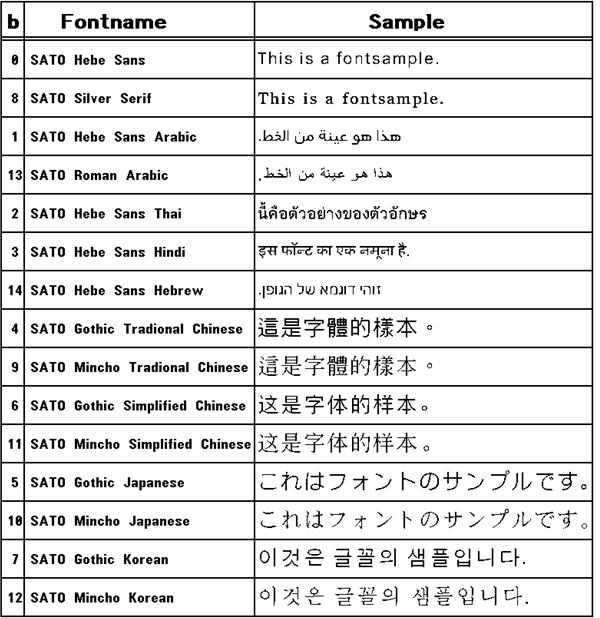
Print sample in following condition: Head density: 8 dots/mm, 28 x 28 points