[ESC+T2] 24 x 24 dots External Font Registration
Hexadecimal code
| ESC | <1B>16 |
|---|---|
| T2 | <54>16<32>16 |
Parameter
abbn...n
Initial value
Nil
Valid range and term of command
| When the power switch is OFF | The set parameter is not maintained. |
| Valid range within items | The set parameter becomes invalid. |
| Valid range between items | The set parameter becomes invalid. |
Function
Invokes vertical external characters saved in the printer memory to print out.
Format
<T2>abbn...n
-
Parameter
a [Registration data selection]
= H: Registration code in HEX character.
= B: Registration code in binary code.
b [Registration font code address]
Using Kanji set <KS> command to set Japanese (0, 1, 2)
JIS code
H: Up to 95 registrations from "21" to "7F" is available.
B: Up to 95 registrations from 21H to 7FH is available.
Shift JIS code
H: Up to 95 registrations from "40" to "9E" is available.
B: Up to 95 registrations from 40H to 9EH is available.
Unicode (UTF-16BE, UTF-8)
H: Up to 95 registrations from "00" to "5E" is available.
B: Up to 95 registrations from 00H to 5EH is available.
Using Kanji set <KS> command to set other than Japanese
(3 (China Simplified Chinese), 5 (China Traditional Chinese), 6 (Korean)), B18030, BIG5, KSC5601 (EUC-KR) code
H: Up to 95 registrations from "21" to "7F" is available.
B: Up to 95 registrations from 21H to 7FH is available.
Unicode (UTF-8)
H: Can be registered up to 95 ; range: "00"to"5E"
B: Can be registered up to 95 ; range: "00H" to "5EH"
(Note: UTF-8 is not supported with FX3-LX, PW208/PW208m)
n [Registered external font data] = Data
Coding Example 1
Registration data in JIS HEX character
<A>
<KS>0
<KC>0
<CC>0
<T2>H21
00FF ・・・・・・・・・・FF00
<Z>

<A>
<KS>0
<KC>0
<CC>0
<V>100<H>200<K2>H9021
<Q>2
<Z>
Coding Example 2
Registration code in Shift JIS binary code.
<A>
<KS>0
<KC>1
<CC>0
<T2>B<40>16
<00FF ・・・・・・・・・・FF00>16
<Z>

<A>
<KS>0
<KC>1
<CC>0
<V>100<H>200<K2>B<90>16<40>16
<Q>2
<Z>
Coding Example 3
Registration code in Unicode binary code.
<A>
<KS>0
<KC>2
<CC>0
<T2>B<00>16
<00FF ・・・・・・・・・・FF00>16
<Z>

<A>
<KS>0
<KC>2
<V>100<H>200<K2>B<E0>16<00>16
<Q>2
<Z>
Coding Example 4
Register in the user registration memory
<A>
<KS>0
<KC>1
<CC>1
<T2>B<41>16
<00FF ・・・・・・・・・・FF00>16
<Z>
Supplemental explanation
- Registering 24 x 24dots external fonts in the internal memory or user registration memory.
- The code to specify in the registration font code address needs to match the Kanji set (<KS>) and Kanji code (<KC>).
- Overwriting registration data is available.
- The order of data output is as follows.
- The data registered in the printer memory will be deleted at the power off. In this case, you need to register the data again.
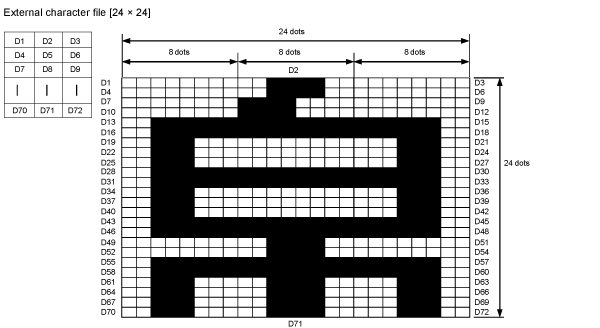
When registering the external characters described above, D1 data becomes <00>16, D2 data becomes <3C>16 and D3 data becomes <00>16 because D1 consists of [00000000], D2 consists of [00111100] and D3 consists of [00000000].
In the same manner, D4 becomes <00>16, D5 becomes <3C>16 and D6 becomes <00>16, and the external registration data are specified to <003C00003C00...> 16 and up to D72.
Point
- The data registered in the user registration memory will be maintained after the printer's power is off.
- You cannot use the internal memory in combination with the user registration memory.
- Specify the slot to register.
If <CC> command is not sent after the power on, the data are registered in the internal memory.